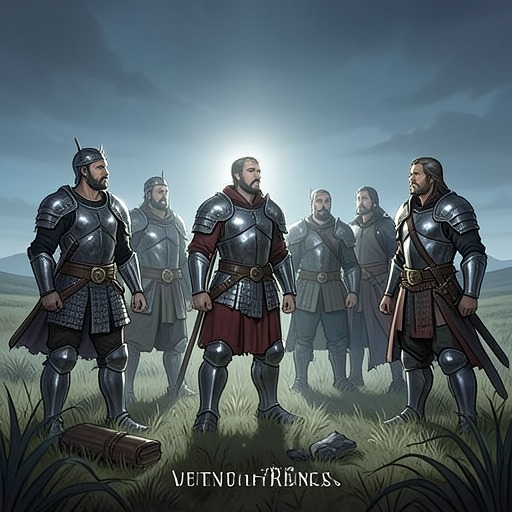
Talenel’Elin
The Way of KingsTalenel’Elin is the Herald whose absence defines the moral and apocalyptic crisis at the heart of these scenes. He is the only member of the group whose Blade is missing when the surviving Heralds abandon the Oathpact, yet he is not gone in any simple sense: he has died defending a passage, been left behind to suffer, and later appears at a remote gate claiming that the Desolation has returned. His story turns a supposed victory into an act of abandonment and makes his damaged return the first unmistakable warning that the old order has collapsed.
Identity and Place Among the Heralds
Talenel’Elin is identified as a Herald of the Almighty, and his aliases include Taln and Talenel. Within the surviving Heralds’ account, he is the absent tenth figure: the one whose sword should complete the ring but does not. Kalak learns that Talenel died while holding a passage by the northern waterway, and the loss is treated as both familiar and devastating. Talenel has a tendency to choose seemingly hopeless fights and win them, but also to die in the process. The description makes courage inseparable from self-destruction: victory does not spare him, and death does not release him from the larger burden attached to the Heralds.
His position is therefore defined less by ordinary presence than by the gap he leaves behind. When the swords are placed in a circle, one spot remains open for the missing Blade. That physical vacancy gives shape to the group’s betrayal. Talenel is not merely one warrior among many; he is the person whose continued suffering permits the others to imagine that they can depart, declare victory, and leave the cycle behind.
Death, Suffering, and Abandonment
Talenel’s death occurs during the aftermath of a Desolation, when the Heralds believe that only one of them has died. The statement is grimly practical: one casualty appears to be an extraordinary success after centuries or millennia of repeated catastrophe. Yet Talenel’s death carries a consequence that the others understand but cannot emotionally bear. He will return to the place where the Heralds go between Desolations, described by Kalak as a place of nightmares.
That interval is not rest. Kalak remembers fires and hooks that tear through flesh day after day, burning skin, fat, and bone. Talenel is the one now consigned to that torture. When Kalak asks about him, Jezrien answers that it is better for one man to suffer than ten, reducing Talenel’s torment to the arithmetic of collective survival. The calculation preserves the others, but it also exposes the ethical wound beneath their decision: the Heralds’ escape depends upon transferring the whole burden of their ancient duty onto the one person who cannot return to share it.
The decision is formalized when Jezrien declares that the Heralds will go their separate ways, will not seek one another, and will leave their Blades behind. The Oathpact ends at the ring of swords. Talenel is not present to consent, defend himself, or contradict the arrangement. His absence makes the pact’s ending unilateral, while Kalak’s final thought—an apology directed toward the abandoned man—acknowledges that the group has not won honorably, whatever story it tells the world.
Return at the Gate
Talenel eventually reappears in a scene that reverses the Heralds’ intended conclusion. A man arrives before two terrified guards, raises an empty hand, and commands them to run, raise the call, and give the warning. He speaks perfect Alethi without an accent, distinguishing him from an ordinary traveler and establishing that his message is directed toward immediate action rather than explanation.
When challenged about his identity, he hesitates, raises a hand to his head, and names himself Talenel’Elin, Stonesinew, Herald of the Almighty. He announces that the Desolation has come, then adds that he has failed. The declaration is both revelation and self-indictment. The return of a Herald should promise authority, protection, or renewed resistance; instead, Talenel arrives wavering and overwhelmed, carrying knowledge that the guards do not yet possess and a conviction that he has been unable to fulfill his duty.
His Shardblade intensifies the strangeness of the appearance. After he collapses onto the rocky ground, the Blade clatters down behind him and does not vanish. The guards approach cautiously and prod him with a spear, but the man who has named himself a Herald does not move. His physical collapse leaves the warning suspended between prophecy and evidence: the Desolation is no longer an ancient memory, yet its herald has returned in a state that makes the truth difficult to receive.
Narrative and Thematic Significance
Talenel’s story is structured around repetition, delay, and the cost of survival. He dies defending a hopeless passage, returns to the place of torment, and is then absent while the other Heralds attempt to end the Oathpact. His later arrival makes the earlier abandonment consequential rather than final. The open place in the ring of swords becomes a recurring image of an unresolved obligation: the tenth position remains empty because the man assigned to bear the burden has been left to bear it alone.
The contrast between the Heralds’ lie and Talenel’s warning is central. Jezrien proposes telling people that they have finally won, perhaps trusting that the lie may become true. Talenel’s entrance destroys that fragile narrative. He does not return with a triumphant account, but with the Desolation itself as the fact that must be faced. His words transform the ending of one cycle into the beginning of another and reveal that the apparent victory rested on exclusion rather than completion.
Talenel also embodies the difference between abandonment and failure. The surviving Heralds abandon him, but he returns believing that he has failed. The evidence does not confirm that judgment as an objective fact; instead, it presents a man who has endured an unimaginable duty and still interprets the catastrophe through responsibility to others. That tension makes him more than a prophetic messenger. He is the living remainder of a broken vow, and his damaged body, missing comrades, and persistent warning expose the price concealed by the declaration that the war was over.